

“When I was diagnosed, I had taken on my first executive level job just a year before, and finally felt like I was ‘making it‘.”
AML doesn’t wait for a convenient time, and symptoms in young adults are far too often overlooked or dismissed as simple fatigue or anemia.
About AYA Unfiltered: The Jackson Copeland Foundation exists to help Adolescent and Young Adult (AYA) leukemia patients navigate the overwhelming nature of this terrible disease. AYA Unfiltered is our commitment to telling the whole truth. In this series, we highlight the good, the bad, and the ugly side of leukemia as a young adult—sharing stories of triumph, stories of loss, and the messy reality in between. Today’s story is by AML and stem cell transplant survivor, Shanya Turner:
In May 2025, I noticed I felt warm and found my temperature was around 99.2°. I thought it was a little odd, but didn’t think much of it. However, my mom’s gut knew something was really wrong and she urged me to go to the doctor.
I saw a doctor at urgent care who ruled out flu, covid, mono, and step but let me know I was slightly anemic and needed to follow up on that. I wasn’t too worried, I had been told that before, but it was always the “eat a steak” type of anemia.
My primary care doctor was fantastic throughout this entire profess and I am so thankful for him. At first, he said the best-case scenario was that I had a vitamin deficiency, but that there were a lot of possibilities. He sent me for more tests.
I started getting really freaked out when the symptoms of the anemia got worse and I started feeling short of breath and had a racing heart rate anytime I wasn’t sitting down. One night I was so scared, I went to the emergency room. The doctor there saw my anemia was worsening and at that point I had zero neutrophils. He said those results were normal for a woman my age. He also told me he was sure it was mono, even though I had two negative tests.
I knew he was wrong and was so upset to be dismissed like that.
A few days later, my primary care doctor told me I had Acute Myeloid Leukemia (AML). I was shocked and didn’t know what to say. I asked him if they were sure and he said “Yes, 100% sure”. He let me know he was referring me to Moffitt and BayCare Oncology and to watch for their calls.
An amazing nurse from Moffitt called me a couple of days later to ask my pre-appointment questions. She was concerned about my current condition and let me know she thought I needed to be seen sooner rather than later. She made some calls and called me back later that day and asked me to pack a bag and head to Moffitt’s urgent care right away to be seen. I couldn’t believe it. Obviously, cancer is serious, but knowing she was so concerned she wanted me to be seen right away felt so scary.
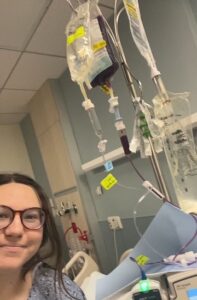
I was admitted that day and remained inpatient for the next 10 weeks.
My first bone marrow biopsy showed my blasts were at 80% and that I had a high-risk type of AML with a complex karyotype. For me, this meant that chemo alone wouldn’t be enough and I would need a bone marrow/stem cell transplant.
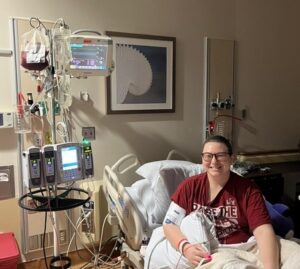
I started with my first induction chemotherapy, Vyxeos (Fun Fact: It’s purple!), which gave me a full body rash. Unfortunately, it only brought my blasts down to 35%. The day my doctor told me that was the first day I cried since I had been admitted. I was so let down. Then, we right away started the second round with a different treatment, a group of chemotherapies called CLAG-M, which made me lose my hair. But luckily, that round got me to zero residual disease and I was ready to move on to the next step!
During induction, I spent my time crafting and working on Lego flowers, working some, and meeting some fantastic nurses. My family was amazing throughout my time there, taking shifts to come and stay with me, and my friends were great at supporting me emotionally and logistically.
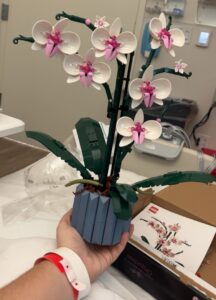
For the next three months, I prepared for transplant through all the testing and by keeping myself isolated and protected from any illness that would hold me back. On October 26, I was admitted to Moffitt again to start the conditioning chemotherapy for the stem cell transplant I received on spooky Halloween. I am extremely thankful for my donor, who was a stranger to me, a 20 year old living in Germany.
The conditioning chemotherapy had very intense side effects, leaving me with mucositis in my mouth and throat and on a pain pump and receiving IV nutrition for days while I slept. The transplant itself went smoothly and seemed as simple as getting a blood transfusion. Luckily, the cells engrafted quickly and started producing healthy blood cells right away!
Almost immediately, I started suffering from GI graft-vs-host disease (GVHD) and felt very sick for many days. I couldn’t eat or hold down food and had to be kept inpatient while I recovered from that using steroids. Luckily, after about a week of steroids, I began to recover and could head home! After leaving inpatient, I stayed with my stepmom in an Airbnb near Moffitt as I recovered for the next two months before I transitioned completely back to my apartment.
I am still dealing with the side effects of steroid use, including wasted muscles. The doctors also suspect I have been dealing with liver GVHD, but that is currently being controlled by medication. In June 2026, my doctors allowed me to return to my office 1-2 days a week, as long as I continue to stay safe and wear a mask. I am currently working on regaining my strength. I joined the Moffitt Adolescent and Young Adult (AYA) community and attended events with my peers. The team does a great job at allowing us to connect and have fun. We recently took a tour of a Moffitt research facility and got to see some of the areas where they work with different cells for cellular therapy!
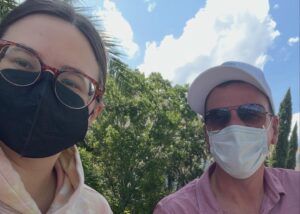
For me, this “after” period is much harder emotionally. I think it’s because while you are getting treatment, there is so much going on, all you can really do is put one foot in front of the other and keep going. Now, I am starting to process everything, but I am so thankful to have a wonderful and robust support system to help me through it, and the connections I have made with people who understand what it is like to go through this as a young adult.
When I was diagnosed, I had taken on my first executive level job just a year before and finally felt like I was “making it.” I feel like this last year and a half has put a pause on everything I had been working on and has made me reset and regroup before I continue on. However, I am so happy to be disease free and continuing to recover!
Thank you to the Jackson Copeland Foundation for all the work they do to support young adults with AML! The journey is definitely not easy, and we can use all the help we can get!
Leave a Reply